致命魔术
China reports 522,000 new COVID-19 cases, one death in July amid fluctuating upward trend_我的网站

一 | 本篇评级为★★★,主要围绕以下内容展开: 1、斩首行动后,战争会失控吗?如何看原油等资源行业? 2、算力硬件"第二春",持续性如何? 如有疑问请以音频内容为准,添加妙投小虎哥微信miaotou515,入群有机会与董小姐进一步交流。 新闻解读评级说明:五星重磅,四星重要,三星级以下大家选择听。

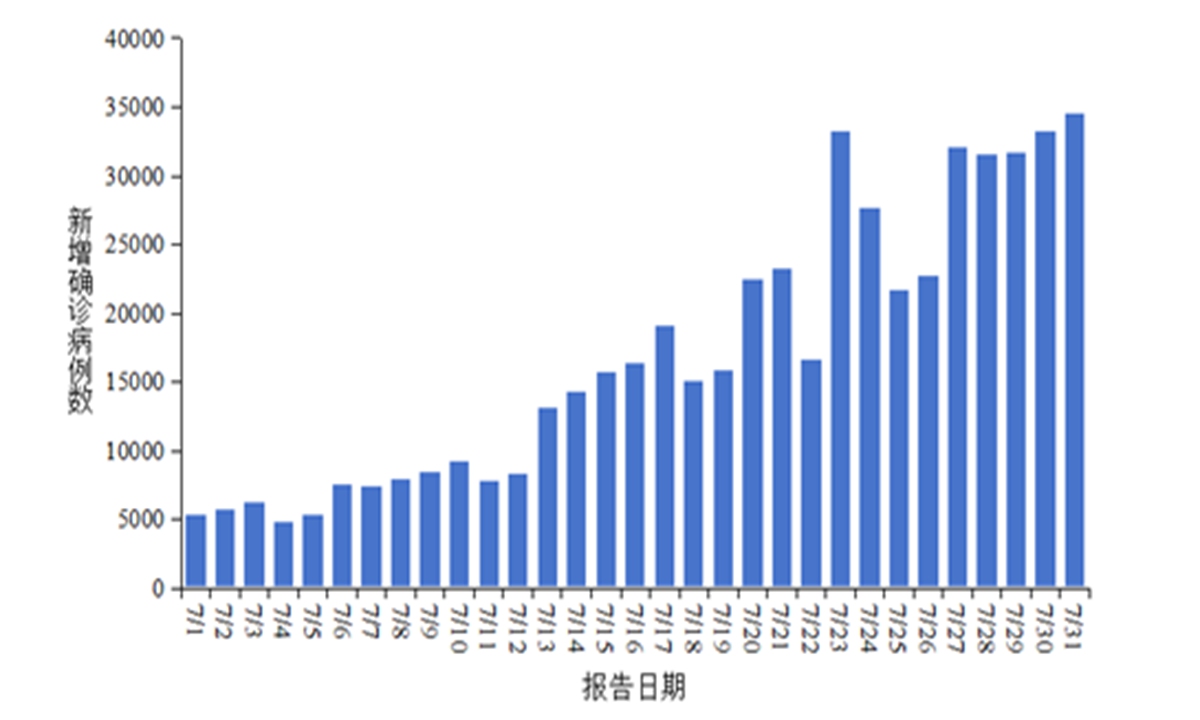
China reported 522,000 newly confirmed COVID-19 cases in July, including 487 severe cases and one related death with cases showing a fluctuating upward trend, China's national disease control authority said.
The current uptick in infections represents another regular cyclical wave, with its severity comparable to surges seen in the past two years. The upward growth curve has slowed markedly, and the country is now on the plateau phase of this epidemic peak, said the Chinese Center for Disease Control and Prevention (Chinese CDC) on Thursday.
All tested infection samples were confirmed to be the Omicron variant, with the NB.1.8.1 strain and its sublineages accounting for the majority of circulating cases, the Chinese CDC said.
A Beijing-based respiratory disease specialist told the Global Times that waning population immunity, continued virus mutations that weaken existing antibody protection, and increased summer travel have contributed to the recent modest rise in infections. However, there is no evidence that the virus has become more pathogenic. Nationwide infections appear to be nearing their peak and case numbers may begin falling in late August.
According to sentinel hospital surveillance data, from June 29-July 5 to July 27-August 2, the proportion of influenza-like illness among all outpatient and emergency visits at China's 1,041 COVID-19 and influenza sentinel hospitals edged up with slight fluctuations, standing at 4.3 percent, 4.4 percent, 4.5 percent, 4.4 percent and 4.5 percent, respectively.
During the same period, the COVID-19 positivity rate among patients with influenza-like illness in outpatient and emergency departments rose for consecutive weeks.
Several factors drove the fluctuating rise in COVID-19 cases in July. Population immunity has waned, as more than six months have passed since the last major wave of infections for most people, while continued SARS-CoV-2 mutations have reduced the protection provided by existing antibodies, Li Tongzeng, a respiratory disease medic from Beijing You An Hospital to the Capital Medical University, told the Global Times on Friday.
These factors, combined with increased travel and population mobility during the summer vacation, contributed to the recent small-scale surge. Based on patterns observed in recent years, COVID-19 infections tend to rise every six to eight months as population immunity declines, said Li.
The expert noted that while the virus continues to mutate, there is no evidence that it has become more pathogenic. Clinical data show that most patients develop only mild symptoms, with very few progressing to pneumonia or requiring hospitalization.
The Chinese CDC noted on Thursday that since COVID-19 was reclassified as a Category B infectious disease under Category B management, it has evolved into a prevalent, recurring respiratory infectious disease in China, with one to two epidemic fluctuations occurring nationwide each year.
Li also noted that residual immunity from previous infections also helps reduce disease severity, with most reinfections presenting as mild upper respiratory symptoms that resolve within about a week. The single COVID-related death reported nationwide in July further indicates that the current fatality rate remains very low.
Judging from historical epidemic patterns and current case growth trajectories, national infection figures may begin to decline in late August. Nationwide case numbers are now nearly at their peak, with declines already observed in some regions, said Li.
The Chinese CDC also said on Thursday that surveillance had not detected any variants posing major public health risks, nor had the current wave caused notable disruptions to the healthcare system.
The public is advised to take appropriate protective measures, including wearing masks when necessary, maintaining good personal hygiene, adopting healthy lifestyles and getting vaccinated as recommended.
。 1、斩首行动后,战争会失控吗?如何看原油等资源行业? 今天国内市场出现了修复性的上涨,那是不是开始对3月份、4月份的情况乐观了呢?我们说即使某一天艳阳天闪现一下,但整体的动荡是没有止歇的。最近这段时间还是以保守策略为主,我们一起来看一下这两天发生的重要消息,理一理我们究竟走到哪里了。 首先关注的是伊朗这边的局势。伊朗虽然跟美国现在表面上是针锋相对,但实际上从动作上、从一些细节上能够看出来,美国和伊朗都是给自己留了后路的。 我们看一下伊朗最新的表态——外长对外发言时说"霍尔木兹海峡不会恢复到战前状态"。

二 | 这句话看上去是强硬派,但实际上琢磨起来,他是给自己留了一个相当大的自由度。

三 | 他没有继续坚持说整个霍尔木兹海峡是瘫痪和持续封锁的状态,"不会恢复到战前状态"其实也是有改善空间的,为未来做出一定让步留有空间。 本文为妙投付费内容,上述仅为摘要,购买本专栏即可解锁完整内容。新用户可免费领本专栏7天阅读体验机会,在妙投APP-我的-权益兑换 输入“妙投888”即可领取。
Current article:http://www.bianhajieleigoukusunmen.pics/ongj2/yjy.doc
Published on:14:53:42